Monday, October 21, 2013
Rokiškis 1943
This is a registered mail sent in 1943 from Rokischken (now Rokiškis, Lithuania) to Wien also under German occupation. Michel calls Rokiškis, "Rakischki" but the correct official German name during WWII was Rokischken. I wouldn't say it is "wrong" because there are several sources that mention about the name Rakischki especially during the WWI period, probably coming from the Polish name Rakiszki. It has a nice arrival cancellation of Wien on the back.
Thursday, October 17, 2013
Vilnius 1920
Unfortunately one stamp is missing but this is a registered postal stationery with added stamps sent on 21 June 1920 from Wilno (now Vilnius, Lithuania) to France. Prior to the formation of Central Lithuania, the Poles occupied Vilnius from 19 April 1919 to 13 July 1920, this card has been used during this period.
It is addressed to a certain Madame A. Hock in Gueugnon in the department of Saône-et-Loire in France but later redirected to Uriage (Uriage-les-Bains) in the department of Isère, which is known to be a spa town. The sender's name Helene Kwasser also doesn't seem Russian (rather German sounding) but their correspondence is clearly in Russian. Hôtel du Gare does not seem to exist in present Uriage anymore.
Vilnius 1937
This is a maximum card of Józef Piłsudski, the Chief of State of the Polish Second Republic, cancelled in Wilno (Vilnius, Lithuania) in 1937 with a commemorative postmark of the exhibition of the 10th anniversary of Radio Wilno, known as "Radio dla miasta i wsi" (Radio for cities and villages) at that time. It was the first permanent radio station in Vilnius. The following year in 1938, the Polish Radio released a publication about the contents of the exhibition which, thanks to the Polish National Digital Library, we are able to see. Here is the link.
Sunday, October 13, 2013
Palanga 1943
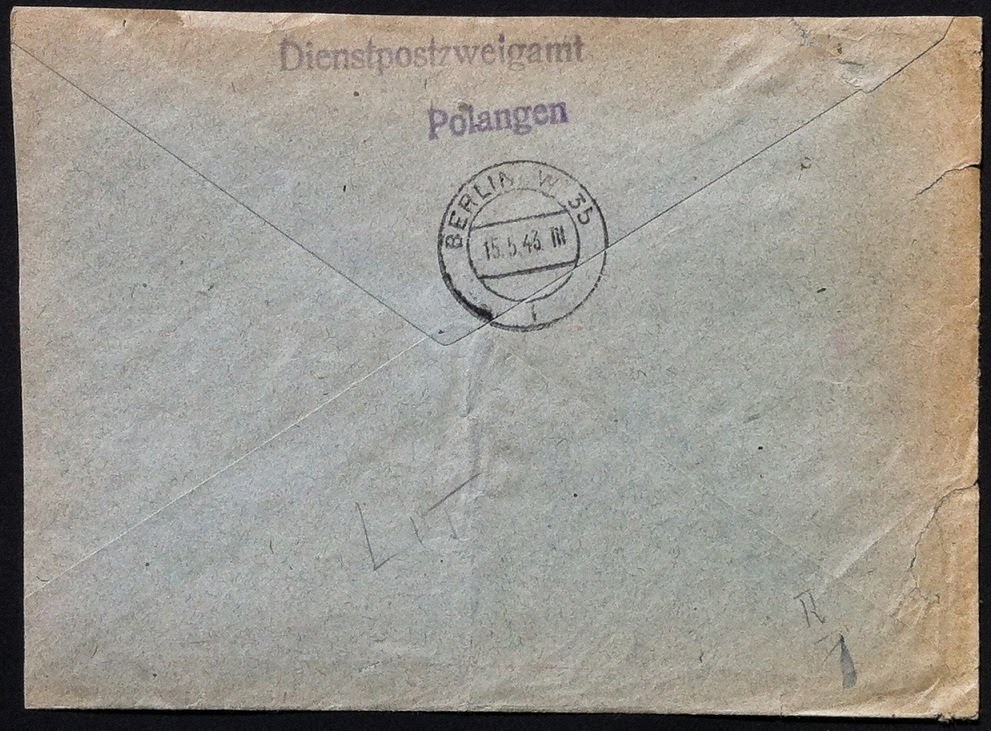
This is a stampless official use registered cover sent in 1943 from Polangen (now Palanga, Lithuania) to Berlin, Germany. The sender is the Dienstpostzweigamt Polangen, a branch of Dienstpost Ostland post offices which was the postal authority of the region during the German occupation in large part of Lithuania. The term "postlagernd" is the equivalent of Poste-restante.
Thursday, October 3, 2013
Gilandviršiai 1914
Queen Louise Bridge, the border between Sovietsk and Panemunė
Sterpeiken (now Strepeikiai, Lithuania), 9.21 1914
Gillandwirszen (center) and Sterpeiken (left) on a 1861 map
This is a German military field post (Feldpost) card sent in 1914 from Gillandwirszen (now Gilandviršiai, Lithuania). According to the list of post offices of Memelgebiet provided by Michel Deutschland Spezial, the post office of Gillandwirszen has closed down on the 1st of December 1923. The postmark on the scan with the inscription "Kr. Tilsit" has been used during pre-Memelgebiet period as well as after the Treaty of Versaille along with the newly created postmark with the inscription "Memelgebiet". Gillandwirszen has been later incorporated into Kreis Pogegen and during Nazi re-annexation into Kreis Tilsit-Ragnit. Today, Gilandviršiai is part of Tauragės apskritis/Tauragė county with the population of 55 according to 2001 census. If you look closely to the card, the author actually wrote it in Sterpeiken (now Strepeikiai) which is a village right next to Gillandwirszen.
The picture on the card is Queen Louise Bridge which linked Tilsit (now Sovietsk, Russia) and Übermemel (now Panemunė, Lithuania) over the Memel (Nemunas in Lithuanian) river. It has been named after the Queen Louise who resided at the city of Memel (now Klaipėda, Lithuania) when it served as the temporary capital of the kingdom of Prussia during the Napoleonic wars. The bridge still exists today and serves as the Russo-Lithuanian border.
Monday, September 9, 2013
Utena 1913
This is an Imperial Russian postal stationery sent in 1913 from Уцяны/Utsyany (now Utena, Lithuania), Ков (Kovna/Kaunas Gubernia) to Варшава/Varshava (Warszawa/Warsaw, Poland). The sender is obviously Jewish, you see on the back the Hebrew text which I have absolutely no idea what is it written about unfortunately. Utena was historically known for it's Jewish population, according to the 1875 Russian census, 75% of the population of the city was Jewish. It has a nice arrival cancel of Варшава/Warszawa.
Monday, September 2, 2013
Kaunas 1941
The cover itself is not in perfect condition but I have decided to post it because the postmarks are clear and stamps are undamaged. This is a registered cover sent on 31.3.1941 from Каунас/Kaunas to Ленинград/Leningrad (now Saint Petersburg, Russia) during the first annexation to the Soviet Union. The cover arrived on 3.4 and delivered on 4.4 according to the arrival postmark on the back. Lithuanian has been annexed by the Soviet Union on 1940 and Nazi Germany took Kaunas on 25.6.1941, not even 3 months after this cover has been used.
Thursday, August 22, 2013
Kaunas - pre-Aleksotas bridge
pre-Aleksotas bridge
Feldpost station 209 used in 1916
This cards was used in 1916 but the picture was probably taken earlier than the first card.
You see the top of one of the twin bell towers of the white baroque church has been destroyed,
but in the first card you see it has been restored.
The same bridge from the other side of Nenumas river.
Construction of Aleksotas bridge
I have noticed that many visitors of this blog come from websites that deal with old pictures and postcards. I haven't posted much comparing to the size of my collection because I didn't find those postally interesting, but since I have received several requests, I decided to post more postcards. Today, I have posted few cards of the bridges in Kaunas. There was a provisional military-made bridge approximately 100 meters east of the present Vytauto Didžiojo tiltas (Vytautas the Great bridge) which you see in the first 3 postcards. The last 2 postcards show you the construction and the completion of Aleksoto tiltas (Aleksotas bridge) which is called now Vytauto Didžiojo tiltas. All of the postcards are postally used by the WW1 German field post (Feldpost) station 209 except the last one which was printed during the First Republic.
Subscribe to:
Posts (Atom)