Showing posts with label Kudirkos Naumiestis. Show all posts
Saturday, November 21, 2015
Kudirkos Naumiestis 1941
Wow... I mean, this was a pure coincidence that I did bump up to such Soviet stamps. Who would expect to see a 1941 Kudirkos Naumiestis postmark on a Soviet definitive, just like that... More over, the date is June 22nd 1941, day one of the Operation Barbarossa, the German invasion of Soviet Union. Kudirkos Naumiestis was located near to the German border at that time so probably by the end of the day, the entire city was on the German hands which means that it is also the final day of the first Soviet Annexation of Lithuania and their postal service as well of course. It seems like they weren't using CCCP postmark but the old "Naumiestis Trg." postmarker from the first Lithuanian Republic which was pretty common in regional towns at that time. The stamps still have gum on the back which suggests that it is a CTO. I have once read an article about a German Dienstpost Ostland post office worker in Tallinn, Estonia, cancelling stamps with CTO on the last minute before closing down the post office in 1944 when Soviet troops were about to reach the city. I don't know about Kudirkos Naumiestis but I can believe if something similar happened there as well.
Monday, January 20, 2014
Kudirkos Naumiestis 1918
This is a Postgebiet ob. Ost overprinted postal stationery sent in 1918 from Wladislawow (now Kudirkos Naumiestis, Lithuania) to the Kriegsgefangenenlager Stammlager (P.O.W. camp) in Preußisch Holland (now Pasłęk, Poland). The sender's name is a certain Anton Kunzaitis and it is addressed to Konstantin Kunzaitis (or Kuncaitis?), probably held as a prisoner in Preußisch Holland. The card has a postmark of Wladislawow but the sender's address is in Gielgudischki (now Gelgaudiškis, Lithuania) which probably derives from the Polish name Giełgudyszki, located just 1km south west of the famous Panemunė Castle (Not Panemunė, the former Memelgebiet town!) and according to the card, it used to be part of the postal district of Kreis Wladislawow, postamt Szaki (now Šakiai, Lithuania).
By the way, the famous English actor John Gielgud's descendants are from a Polish noble family of Lithuanian origin who owned Giełgudyszki.
Monday, March 19, 2012
Kudirkos Naumiestis 1914

![]() |
| Владиславов / Vladislavov (now Kudirkos Naumiestis, Lithuania) |
![]() |
| Юрбург / Jurburg (now Jurbarkas, Lithuania) |
Tuesday, February 8, 2011
Cancellations of Postgebiet Ob.Ost
"Postgebiet Ob.Ost" stands for Postgebiet Oberbefehlshaber Ost, which means: Postal district of the Supreme Commander in the East.
Tuesday, November 30, 2010
Kudirkos Naumiestis 1916
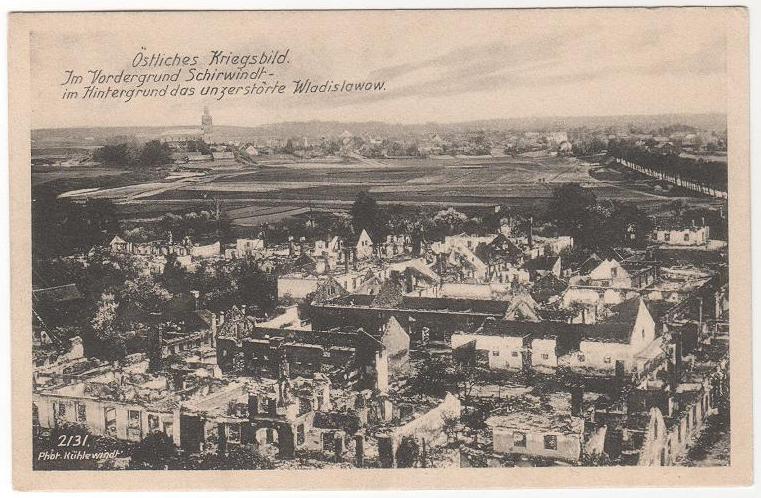
Feldpost card posted from the Feldpost station 209 by the Rekruten Depot of the 11th corps in 1916. They were mainly active around Kaunas at that time. Wladislawow is now called Kudirkos Naumiestis and there are several hypothesises of the origin of the name. It is said that originally it was part of the settlement called Širvinta (Schirwindt in german). There is also a river named "Širvinta" in Lithuania but it does not reach Kudirkos Naumiestis. The settlement became the bordertown of Prussia and Lithuania but falls on the Prussian side. Gradually, a small sub-settlement started to grow on the lithuanian side which the germans reffered as Neustadt-Schirwindt, meaning New-town (Naumiestis in lithuanian) of Schirwindt (Later it was called Russisch Neustadt after the incorporation of Lithuania by the Imperial Russia). "Kudirkos" was later added for the honor of Vincas Kudirka, the composer of the lithuanian national anthem, who died there. The other hypothesis is, the present Šešupė river (Scheschupe in german, from the lithuanian "šeže upis" meaning "dark river") which flows nearby, was called "Širvinta" (from "širvas" an old baltic language meaning "brown" or "dark"). Since there was also another river called Širvinta and the slightly older town of Širvintos, they called the settlement "New-town Širvintos". The polish name Władysławów/Wladislawow came from Władysław IV Vasa who gave the civil rights to the town in 1643.
Those 2 cards were sent from the Feldpost station 213 on the same year. The last card shows the ruin of the town of Schirwindt (now Кутузово/Kutusowo in Kaliningrad oblast, Russia) which is on the german side of the border, and on the back, the undamaged town of Naumiestis/Wladislawow on the lithuanian side. It is interesting that what was at the time "german side" is now Russia, and what was "Imperial Russian side" is now Lithuania.
Subscribe to:
Posts (Atom)