Showing posts with label Military correspondence - Field post. Show all posts
Tuesday, May 24, 2016
Vilnius 1917
This is a postcard sent in 1917 from Wilna (now Vilnius, Lithuania) under the German occupation to Pfafstatt bei Mülhausen in Elsass, now in Alsace, France. It has a nice cachet of the Soldatenheim - Wilna, a recreational establishment for the soldiers, where the card has been sent from. It also has the address on it: Georgstrasse 9 which is the present Gedimino Prospektas. The German name "Georgstrasse", George street. probably comes from the St. George church located right behind the Lithuanian writers' Union building on Gedimino Prospektas.
Wednesday, August 19, 2015
Sejny 1919
![]() |
| Seinai (now Sejny, Poland) 16 May 1919 |
While collecting stamps for years, I'm pretty sure you have experienced a "what I thought it is, actually, wasn't" phenomena at least once. Well, it just happened to me so I thought I would post about it. This is a Lithuania classic stamp, to be precise, a Michel 14. I thought the postmark on it was an early example of Raseiniai postmark, for some reason labeling it so without much thinking. Recently, I was just going through my collection and one particular Raseiniai cancel on an air post stamp caught my eye. Why? well, I thought the size of the letter on the postmark is slightly smaller than the one on my Michel 14. So I took them our and compared, and wow wow wow! it wasn't "slightly" but pretty obvious!
Isn't it possible that 1919 Raseiniai cancel is bigger than the 1924's one? Maybe everybody knows it because it is mentioned in LPS journal and I'm the only one in the world not knowing about it... Or maybe some kind of previously not known Raseiniai cancel? I thought it would be wise to check on Lithuanian Philately.com before arming my fantasies with Icarus's wings.
![]() |
| 1919 Raseiniai and Seinai cancels taken from Lithuanian Philately.com. |
Looking further at my Michel 14 I have noticed that the space between the letter "S" and the previous one is way too wide. So I've looked with the possibility of the letter S being the first letter in my mind as well. Lithuanian Philately.com is really the best site earth can provide when it comes to 1919-1923 Lithuanian postmarks and they once again proved it to me. My Michel 14 is clearly not Raseiniai but it turns out to be Seinai. When compering their 1919 Raseiniai and Seinai cancels, you can see that if you draw up and parallel line at the left edge of the number "9" of the date, the Raseiniai one does not touch the letter "N" but the Seinai one touches big time and so does my Michel 14. So it is Seinai! This was another lesson that you should not label something without much doubt.
Seinai is actually not in present Lithuania. Now it it called Sejny and belongs to Poland. According Lithuania Philately (yes, again), Sejny had a branch of Postgebiet ob. Ost during WWI and later, a Lithuanian post office for little less than 8 months but not consecutively. The Lithuanian postmarker was supplied in early May 1919 so it matches the postmark on my Michel 14 as well.
![]() |
| A military Field Post card sent from Sejny in 1916 during the WWI German occupation |
For further postal history of Seinai, look at the article on Lithuanian Philately: Seinai 1919-1920
Here is a modern Polish FDC cancelled in Sejny with a stamp of the Madonna of Sejny. The church on the cover is St. Mary basilica, a part of the huge castle looking former Dominican monastery where the statue is preserved. I have visited once the town and found the little town very charming, specially the central square filled with bunch of Baroque buildings. I very much recommend it!
Thursday, May 7, 2015
Šiauliai 1916
![]() |
| Schaulen - Postamt / Šiauliai - Post office |
This is a German military field post (Feldpost) card of the post office building in Schaulen (now Šiauliai, Lithuania) sent in 1916 to Bremen, Germany during the WWI German occupation. The postcard tells us only that it is a post office in Šiauliai so I'm sure about exactly which post office it is referring to but I can tell you for sure that it is not the main post office building used during the Imperial Russian time. It is most probably a building occupied by the German military not far from the railway station and used to house the field post office. The card itself has been sent from the field post of the 41st infantry division.
Wednesday, March 11, 2015
Raseiniai 1916
![]() |
| to Czenstochau, Rußland |
This is a German military field post (Feldpost) card of Rossienie (now Raseiniai, Lithuania) sent in 1916 from the field post station of the 78th Reserve Division to Czenstochau, Rußland (now Częstochowa, Poland) also occupied by the Germans during WWI as well. The German name Czenstochau was also spelled Tschenstochau. A district commander's headquaters was located in Raseiniai so even though it was never a major town (and neither is now), it had a Soldatenheim (a sort of officer's club) and a casino like it is shown in the above picture.
Sunday, March 1, 2015
Kaunas 1916
![]() |
| Eisenbahn - Verkehrsamt Kowno / Kowno Railway administration office |
![]() |
| Kowno (Kaunas) 23 April 1916 Feldpost (Field Post) |
This is a German military field post (Feldpost) card sent in 1916 from Kowno (now Kaunas, Lithuania) to München/Munich, Germany during WWI. You can find WWI German field post card without postmark time to time but this time I'm lucky, the sender wrote the location and date on the card: "Kowno 23. 4. 16". Usually there is a cachet of the affiliating unit on most of the field post card unless they are out in the field on action. This one is Eisenbahn - Verkehrsamt Kowno which can be translated as Kowno Railway administration office. During WWI, railways were the key strategic infrastructure so they were often run by the occupying military administration.
Sunday, February 8, 2015
Vilnius arrival cancellation 1915
This is a Russian military field post card sent in 1915 from Митава / Mitava (now Jelgava, Latvia) to Вильна / Vilna (now Vilnius). The arrival postmark is the Russian main field post-office in Вильна/Vilna. ПОЛЕВ. ГЛАВН. ПОЧТ. КОНТ. /Polev. glavn. pocht. kont. is literally "Field main post counter". This post office seemed to be operated in Vilnius from 1914 to 1915 until the German took the city during WWI. There are plenty of documents and literature available in English about WWI German military post but very few about the Russians. I wish I knew more about it.
Tuesday, April 8, 2014
Šiauliai 1966
This is an illustrated Soviet military field post cover sent in 1966 from the post office Шяуляй/Šiauliai 2. The envelope has some nice pictures of Друскининкай / Druskininkai. Most of the field post sent from Šiauliai has a postmark of Šiauliai 4, because this post office was in Zokniai where the biggest military facility in the city, Zokniai military airport (presently used by NATO) was also located. However, Šiauliai 4 has opened sometime at the end of the 1960's so any mail prior to that was posted more from Šiauliai 2, one of the two post offices located in the center of the city.
Monday, January 6, 2014
Kūgeliai 1917
Happy New Year to all visitors!! I would like to start my first post this year with item. It is a German military field post (Feldpost) card sent in 1917 from Kugeleit (now Kūgeliai, Lithuania). This card looks like a postal stationery which the letter part that can be dettached but since the regular field post are sent free, there is no value imprinted so technically speaking, it is not a postal stationery. But then if it is free, can it be a postal stationery? I don't know... According to Wikipedia, Kūgeliai's most recent population is 1! Is it possible? Anyway, I have found some nice pictures of the present Kūgeliai railway station on Miestai.net, here is the link.
Tuesday, December 3, 2013
Joniškis 1916
This is a German field post (Feldpost) card of Janischky (now Joniškis, Lithuania) sent in 1916 from the field post station 264 to Imlingen bei Saarburg, Lothringen, Germany (now Imling, Lorraine, France). Saarburg is also part of France today with the name Sarrebourg.
Joniškis is also a confusing town just like Abeli/Obeliai which I have posted previously, located near the border with Latvia. So far I have encountered the spellings: Janischky, Janiszki, Jonišķi. We see lot of people on the picture, even cars (I see at least 4 of them)... Sunday mass? Wedding? Easter? I can tell it is not during the winter but what is it, I don't know. Joniškis has a big church comparing to the size of the town, with an enormous bell tower you can see from far away when driving from Šiauliai and looks like as if the long straight road is directly leading to this tower. Curiously, same phenomenon happens with the bell tower of the cathedral of Šiauliai when you drive from Joniškis.
Obeliai 1916
This is German military field post (Feldpost) card of Abeli (now Obeliai, Lithuania) sent in 1916 to Scholderup, Schleswig (now Taarstedt, Schleswig-Holstein), Germany. Abeli is very often mistaken to be part of Latvia. This town was mentioned as part of Kurland (Courland) in most of the documents prior to WWI, because the term "Kurland" was purely geographic to most the Germans at that time. Today the simple formula: Kurland = Kurzeme therefore Kurland = "part of Latvia" is followed by most of the non-Latvian people. In addition to this, there is a town called Ambeļi near Daugavpils not far from the Lithuanian border, which for some unknown reason, sometime mistakenly spelled "Abeļi". If you are in doubt to identify a picture, the church you see on this postcard can be your best bet, it remains exactly in the same shape in today's Obeliai.
Sunday, October 13, 2013
Palanga 1943
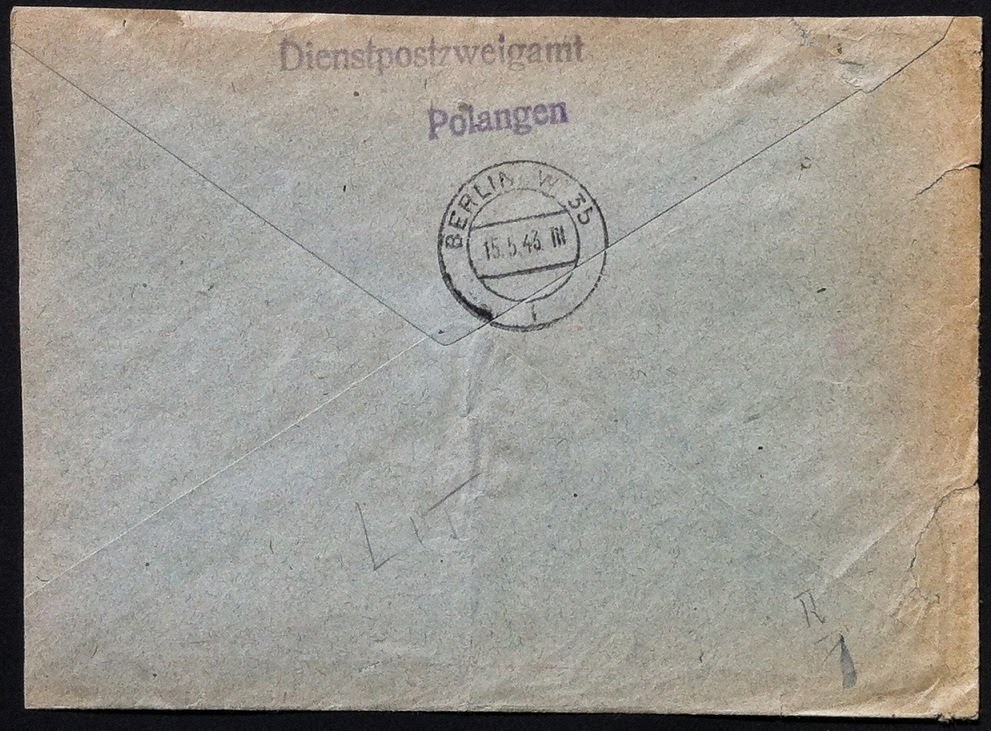
This is a stampless official use registered cover sent in 1943 from Polangen (now Palanga, Lithuania) to Berlin, Germany. The sender is the Dienstpostzweigamt Polangen, a branch of Dienstpost Ostland post offices which was the postal authority of the region during the German occupation in large part of Lithuania. The term "postlagernd" is the equivalent of Poste-restante.
Thursday, October 3, 2013
Gilandviršiai 1914
Queen Louise Bridge, the border between Sovietsk and Panemunė
Sterpeiken (now Strepeikiai, Lithuania), 9.21 1914
Gillandwirszen (center) and Sterpeiken (left) on a 1861 map
This is a German military field post (Feldpost) card sent in 1914 from Gillandwirszen (now Gilandviršiai, Lithuania). According to the list of post offices of Memelgebiet provided by Michel Deutschland Spezial, the post office of Gillandwirszen has closed down on the 1st of December 1923. The postmark on the scan with the inscription "Kr. Tilsit" has been used during pre-Memelgebiet period as well as after the Treaty of Versaille along with the newly created postmark with the inscription "Memelgebiet". Gillandwirszen has been later incorporated into Kreis Pogegen and during Nazi re-annexation into Kreis Tilsit-Ragnit. Today, Gilandviršiai is part of Tauragės apskritis/Tauragė county with the population of 55 according to 2001 census. If you look closely to the card, the author actually wrote it in Sterpeiken (now Strepeikiai) which is a village right next to Gillandwirszen.
The picture on the card is Queen Louise Bridge which linked Tilsit (now Sovietsk, Russia) and Übermemel (now Panemunė, Lithuania) over the Memel (Nemunas in Lithuanian) river. It has been named after the Queen Louise who resided at the city of Memel (now Klaipėda, Lithuania) when it served as the temporary capital of the kingdom of Prussia during the Napoleonic wars. The bridge still exists today and serves as the Russo-Lithuanian border.
Thursday, August 22, 2013
Kaunas - pre-Aleksotas bridge
pre-Aleksotas bridge
Feldpost station 209 used in 1916
This cards was used in 1916 but the picture was probably taken earlier than the first card.
You see the top of one of the twin bell towers of the white baroque church has been destroyed,
but in the first card you see it has been restored.
The same bridge from the other side of Nenumas river.
Construction of Aleksotas bridge
I have noticed that many visitors of this blog come from websites that deal with old pictures and postcards. I haven't posted much comparing to the size of my collection because I didn't find those postally interesting, but since I have received several requests, I decided to post more postcards. Today, I have posted few cards of the bridges in Kaunas. There was a provisional military-made bridge approximately 100 meters east of the present Vytauto Didžiojo tiltas (Vytautas the Great bridge) which you see in the first 3 postcards. The last 2 postcards show you the construction and the completion of Aleksoto tiltas (Aleksotas bridge) which is called now Vytauto Didžiojo tiltas. All of the postcards are postally used by the WW1 German field post (Feldpost) station 209 except the last one which was printed during the First Republic.
Saturday, April 27, 2013
Švenčionėliai 1916
This is a German military field post (Feldpost) card sent in 1916 from Novo Svenziany (Švenčionėliai, Lithuania) to Chateau Salins in Lothringen, Germany (now Lorraine, France). Švenčionėliai was nothing more than couple of houses until the Tsarist authority built a railroad linking Vilnius and Saint Petersburg. The present Švenčionėliai station was build for the town of Švenčionys but because of the distance of 10 Km, a small sub-town started to grow around the station which eventually became "Novo Svenziany", the New Švenčionys.
From what I can see here, it looks like the picture was taken at the intersection of Priestočio g. and Švenčionių g looking to the west. It seems like "Svenziany Str." hasn't changed the name and Priestočio g. is more like a square rather a street like you see on the picture.
You certainly won't see this sign in present Švenčionėliai:
"Horse wagon, do not stop here"
Wednesday, April 24, 2013
Lyduvėnai 1915
![]() |
| Königlich Preußische Reserve Eisenbahn-Bau Compagnie No.5 |
![]() |
| Lidowiany 14.12.15 |
This is a German military field post card sent in 1915 from Lidowiany (now Lyduvėnai, Lithuania) to Berlin, Germany. The picture on the card is actually not Lidowiany but Rossienie (now Raseiniai, Lithuania), showing the local German military commander's headquaters (Lyduvėnai is part of Raseiniai district). There is no postmark on the card but fortunately, the author of the card wrote the date and location: Lidowiany 14.12.15 and there is also the seal of his unit: KGL. PR. RES. EISENB. - BAU-COMPAGNIE No.5 which is the abbreviation for "Königlich Preußische Reserve Eisenbahn-Bau Compagnie", a military unit in charge of railroad construction, and No.5 was located in Lyduvėnai from 1915 to 1916. Their mission was to build a huge wooden railway bridge over Dubysa river to link Tauragė and Radviliškis by railway. The bridge was completed in 1916 and it was one of the biggest wooden bridge in Europe. Due to strategic importance, the Germans rebuilt the bridge in steel in 1918. Today's Lyduvėnai Bridge (Lyduvėnų tiltas in Lithuanian) is the 1951 reconstruction and it is the longest and the highest of all bridges in Lithuania. The Lithuanian post issued a commemorative stamp of this bridge in October 2012. See in the link here.
Wooden bridge of Lyduvėnai 1915-1916 which the
author of the card took part of the construction
(source: miestai.net, not mine)
Subscribe to:
Posts (Atom)