Showing posts with label Memel (WW2 German reannexation). Show all posts

Monday, June 4, 2018

Šilutė 1942


Postmark of Heydekrug March 1942

Sender's address: Kolleschen bei Jonaten Kreis Heydekrug (Ostpr.)

It has been long since I have posted something here the last time I guess.. I'm planning to slowly come back on track!
Anyway.. So, here is a registered cover sent in 1942 from Heydekrug (today Šilutė, Lithuania) to Kassel in mainland Germany. 1942 is in the middle of WWII as we all know and Heydekrug / Šilutė  has been re-annexed by Germany along with the rest of Memelland. I guess the followers of this blog know that but let me mention it just in case if you happened to be new to this blog..
The sender's address is in Kolleschen (previously called Kolletzischken) b. Jonaten, a small village not far from the narrow-gauge line Heydekrug - Jonathen (or Jonaten). I wonder if the sender was working or just happened to be in Heydekrug to send this letter because there were closer post offices from where he was living, notably Jonathen.
I bought this cover at Yahoo Japan with a ridiculous price of 500 JPY (4.50USD or 4.30EUR) along with a Tilsit and a Skaisgirren cover (which I'm not going to post here because those are not part of Lithuania but part of present Russia) buried among hundreds of German covers. Regular dealers don't usually notice Memelland covers unless Memel stamps are used on it.

Sunday, November 29, 2015

Klaipėda 1941


Close up of the picture part

This is a real nice postal stationery featuring an image of Memel (now Klaipėda, Lithuania) issued in 1941 as a part of a big series of beautiful places in the Third Reich. Memel is described as the northernmost city of Greater Germany in the text. It just makes me wonder where is the present northernmost city of Germany...
From my opinion, it would have been a perfect card if there wasn't the head of Hitler on the corner... Well, it's history, what can I do...

Wednesday, October 7, 2015

Šilutė 1944


This is a P.O.W. postage free luftpost / airmail cover sent in 1944 from Heydekrug (now Šilutė, Lithuania) to Camp Ellis in New York, NY in the U.S. Heydekrug / Šilutė is known to be the location of the only major POW camp in Memelland but it is just coincidence, this card has nothing to do with the POW camp in Heydekrug. It is a cover sent from a family member of the German officer held as a prisoner in Ellis island in New York. It has traces of the censorship by both authorities, American and German. The returning address is written as the post office of Tennetal, Kreis Heydekrug. Tennetal was called Ramutten but renamed by the Nazi authotiry on May 1st 1939 until the end of the WWII. Today it is called Ramučiai. 

Tuesday, August 25, 2015

Nida 1942


Postmark of Nidden (Ostpr) / (East Prussia)

This is a lovely postcard of a moose sent in 1942 from Nidden (now Nida, Lithuania) to I think... Lublin (or is it Berlin?). I guess I've posted a postcard of a moose sent from Memel before on this blog but here we go again! I really don't know why there are so many moose in this region, it was even the symbol of the city Tilsit with the famous statue of a moose which you see sometime on old postcards. Not only it has a very neat postmark but I've found it with a price of 5 euros so I just couldn't resist from buying it.

Monday, August 24, 2015

Klaipėda 1940


It is a very nice looking German commemorative postal stationery cancelled in 1940 in Memel (now Klaipėda, Lithuania). The postmark is also a commemorative one, both for the occasion of the day of the postage stamp of January 7th 1940. The card has an old good German classic design which makes you almost forget that it has been issued under the Nazi regime.

Tuesday, July 28, 2015

Klaipėda 1940


This is a cover sent in 1940 during the WWII German reannexation period, from the post office Memel 2 (now Klaipėda, Lithuania) to Wiesbaden, Germany. At the time, most of the city's important functions were concentrated in New Town (Naujamiestis) including the city hall, main post office Memel 1, exchange building and so on, and the Old Town (Senamiestis) was rather an area with storage places for goods dealt at the port, pubs and cheap inns. The post office Memel 2 was located there. You can see the sender's address on the back of the cover, Mühlenstr was a part of the present Pilies street on the south eastern side of the former Memelburg castle site.

Sunday, July 5, 2015

Preila 1939


Kurische Haff / Kuršių marios / Curonian lagoon


Unfortunately the edge had been cut out for some reason but I didn't hesitate to buy this postcard because of the rare postmark. It is a postcard send in 1939 by the German Landpost from Preil (now Preila, Lithuania) to... I think Berlin O. (Ost) but I'm not sure. It could be Lublin as well, at the time part of the German occupied Poland. Landpost is a German postal service provided for an area without a post office. It usually has a violet rectangular cancel without date and a regular round cancel of the affiliating post office sometime with the inscription "Land". Most of those rectangular cancels carry an extra information like "Kreis ???" as you see in this case or "über ??? (nearby town's name)" because the area served by the Landpost is in most of the case a remote area of some kind or almost without inhabitant. There was no post office in Preila during the Memelgebiet period as well as the WWII reannexation period. As far as I know, there is no comprehensive list of the former Memelland Landpost postmarks ever published so if you do know something, please let me know, I would greatly appreciate it!

Sunday, May 3, 2015

Lauksargiai 1941


This is a German semi-postal stationery sent in 1941 from Laugszargen (now Lauksargiai, Lithuania) to Göttingen, Germany. It has a nice commemorative cancel of "Rückführung der Volksdeutschen aus Litauen" which can be translated as the repatriation of ethnic Germans from Lithuania. Laugszargen was a town in former Memelgebiet with a railway station bordering Lithuania. When it was re-annexed by the Third Reich in 1939, it served has repatriation gate to Germany for the ethnic Germans living in Lithuania.

Monday, March 2, 2015

Klaipėda 1939


This is a cover sent in 1939 from Memel (now Klaipėda, Lithuania) to Næstved, Denmark. The name  Herlufsholm on the cover sounds like the name of a town or a village but it is actually a famous boarding school in Denmark founded sometime in the 2nd half of 16th century. The stamp used on the cover are a local issue for Memel, overprinted on the Lithuanian stamps similar to the ones issued in Sudetenland with the overprints "Wir Sind Frei". It is very interesting that those stamps were valid to be sent internationally to Denmark which was not yet occupied by the Germans at that time, unlike Memel. Those were recognized as a Lithuanian stamp by the Danish postal authority.

Friday, February 20, 2015

Klaipėda 1943


Faßt Kohlenklau! (Catch the coal thief!)
That's how the IIIrd Reich coal thief looks like

Sender stays at the Hotel Viktoria in Memel

This is a postal stationery sent in 1943 from Memel (now Klaipėda, Lithuania) to Straßburg (now Strasbourg, France) which was re-annexed by the Third Reich at the time just like Memel was. It has a comical looking anti-coal thief "Faßt Kohlenklau!" campaign logo on the left bottom corner. I guess there were many thieves targeting coal supply during WWII in Germany, otherwise they wouldn't have such campaign, would they?
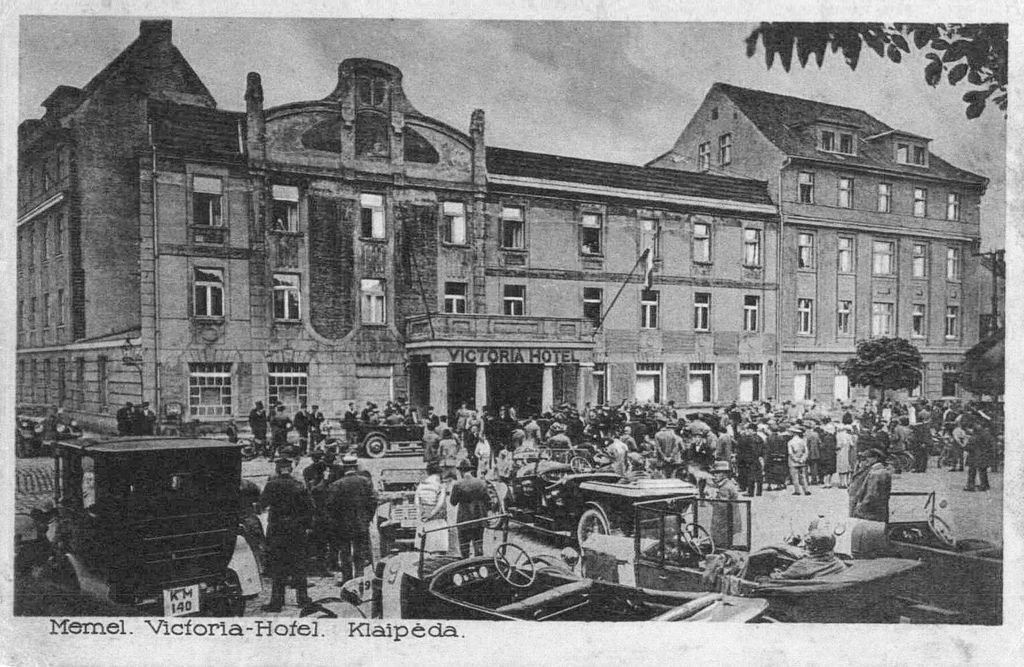
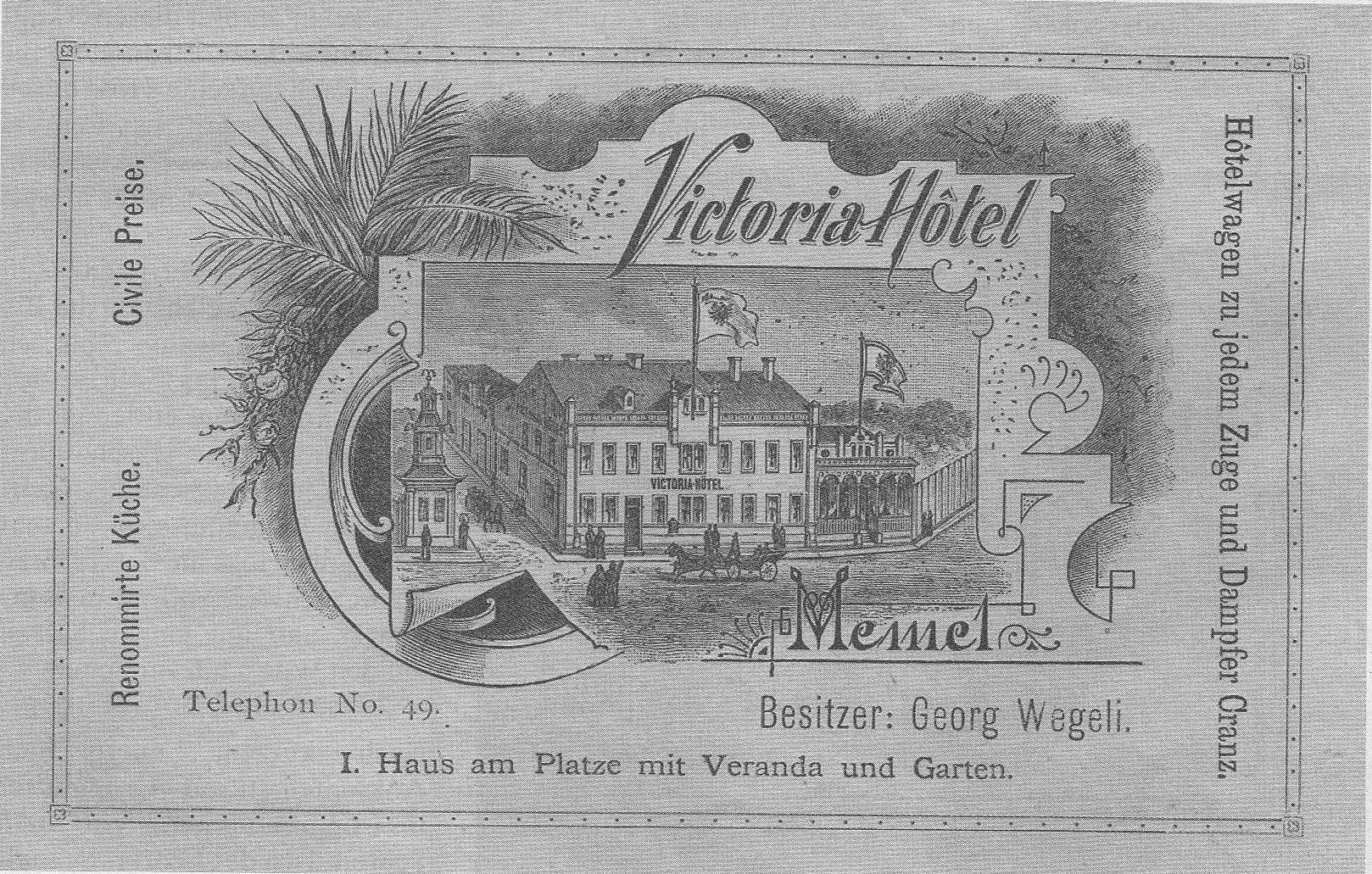
The sender stayed at the Viktoria Hotel which was a wonderful Jugendstil architecture now unfortunately destroyed. It was named "Victoria Viešbutis/Hotel" during the Lithuanian time but after the Nazi re-annexation, they've changed the spelling to "Viktoria". This hotel at the address Polangenstraße Nr. 5 was originally called "Lipper's Hotel" when it opened back in 1858.

Victoria Hotel during the Lithuanian period (picture from wiki-de.genealogy.net, not mine)

Hotel card of the pre-Lithuanian period (also from wiki-de.genealogy.net)

Monday, December 1, 2014

Recent Acquisitions

Lately I haven't been able to have enough time to neither acquire new covers nor time for posting threads... However, here are some stamps I have found recently in various sources.


Memel Local issue
Postmark Memel 25.03.1939

Not new to this blog but another copy of Fuhrer's 50th anniversary
 with an illustration of the Municipal theater in Memel

Central Lithuania (I personally prefer to translate it "Middle Lithuania")
Postmark Troki (now Trakai, Lithuania) 7.1922

Вилыкомıр/Vilkomir (now Ukmergė, Lithuania) 15.IV.190?


Monday, April 14, 2014

German stamps in Lithuania

When I write "German Reich stamps in Lithuania", most philatelist probably comes up with Memel related stamps or the occupation issues such as Postgebiet ob Ost. or Ostland. Well, I should say that's the right reaction but that is not all. There were some regular German stamps that have been used in Lithuania under different circumstances. I have mentioned before in this blog that I do collect Soviet stamps but having difficulties because of the criteria of my collection: all non-Lithuania themed stamps must be cancelled in Lithuania. The exact same criteria applies to the regular German Reich stamps as well, which makes again, collecting German stamps very difficult. There are several cases when these stamps were used in Lithuania, I would like list those in chronological order.

1. Pre-Memelgebiet stamp
99% of the regular Reich stamp that has been issued before 1920 could have been used in the Memel region. When I search German stamps in an internet auction, I usually ignore post-1920 Reich stamps up to 1939 to go faster. However, this does not mean that there is absolutely no way to find any postmark of the Memel area on a Reich stamp between 1920 and 1939 (for example, railway postmark Insterburg-Memel used in Tilsit could be on a post-1920 Reich stamp).
Pre-Reich stamps or also called Old German states' stamps were used in Memel region as well but only the stamps of Prussia and the North German Confederation.

Memel postmark of 1886 on a Reich stamp
2. Postgebiet Oberbefehlshaber Ost area
These areas occupied by the Germans during World War I basically used German stamps overprinted "Postgebiet ob. Ost" but in some cases, regular Reich stamps were used mainly by the private postal delivery services. It is very difficult to find. Believe me... 

3. Re-Annexation of Memel region
Nazi Germany re-annexed Memel region on March 1939 and used regular Reich stamps until the Soviet armies took the region in 1945. I would not say "frequently found" but those are relatively easy to find.


4. Ostland
Ostland had its own overprinted stamp but regular Reich stamps were also valid through out the territory. As a result of the mass-production of Ostland stamps, the use of regular Reich stamps were limited. 

Postmark of Schaulen (Šiauliai, Lithuania) on regular Reich stamps
Schaulen postmark used for precancellation or also for parcel

Those were the 4 cases where regular Reich stamps were used in the present territory of Lithuania for postal use. If I'm missing any cases, please feel free to comment on this post. 

Saturday, February 9, 2013

Klaipėda 1940


This is a postcard sent in 1940 from Memel (now Klaipėda, Lithuania) to Berlin, Germany. The building shown on the picture postcard covered by numerous Nazi Swastika/Hakenkreuz is the old city hall, once used as the Royal residence of Prussian King Friedrich Wilhelm III and his wife Queen Luise between 1807 and 1808 during the Napoleonic war, when Memel/Klaipėda was the temporary capital of the Kingdom. Today, what we see on this picture postcard is pretty much the same except for the Swastikas and the statue of Borussia (personification of Prussia) which has been replaced by a different one.

Sunday, January 27, 2013

Šilutė 1944


This is an interesting P.O.W. camp cover sent on 14 March 1944 from the Stalag Luft 6 in Heydekrug (now Šilutė, Lithuania) to the British Red Cross in London. UK. "kriegsgefangenenpost" (written on the top of the cover) is franking-free P.O.W. (prisoner of war) post. It looks like the author is a British officer named Sergeant A.G. Fripp. According to Wikipedia, "Stalag" is an abbreviation for Stammlager which itself is also an abbreviation of "Kriegsgefangenen-Mannschafts-Stammlager" which is the term used for the prisoner of war camps. Considering the absence of reinforcements and supplies, the Germans defended Memelland effectively, it was only on January 1945 that Soviet forces fully gained the district of Memel/Klaipėda.

Thursday, January 10, 2013

Rusnė 1942


This is a card sent in 1942 from Ruß/Russ (now Rusnė, Lithuania) to Recklinghausen in North Rhine-Westphalia, Germany. Rusnė/Ruß is an old picturesque small town with a population of 2000 located on an island called Rusnė Island/Rusnės Sala in the delta formed by the Nemunas/Memel river. The postmark states "Ostpr." (Ostpreußen) to differentiate from another town also called Russ/Ruß in Alsace, France which was at that time, part of Germany.

Wednesday, January 9, 2013

Šilutė 1939


This is a postcard of Kurische Nehrung/Kuršių Nerija from the same series as the previous post, sent in 1939 from Heydekrug (now Šilutė, Lithuania) to Berlin, Germany. The Memel territory (Klaipėda region) was re-annexed by Nazi Germany on 23 March 1939, this, of course included Šilutė/Heydekrug, the 2nd largest town of the region. Although in 1818 the town became the district center of Landkreis Heydekrug, it never received the city right until 1941, which is very unusual.

Tuesday, January 8, 2013

Nida 1942


Happy New Year to all readers! This year's first post is a postcard of Kurische Nehrung/Kuršių Nerija cancelled in 1942 in Nidden (now Nida, Lithuania). Kuršių Nerija is a sand dune spit known as Curonian Spit in English, stretching 98km like a corridor in the middle of ocean. Presently, the northern half of the spit is belonging to Lithuania and the southern half what used be part of Ostpreußen/East Prussia now belongs to Russia, Kalininglad Oblast. Nida/Nidden is a virtual "small fishing village" tourist resort since the 18th century with summer residents and cottages of celebrities such as Queen Louise of Prussia or the Nobel prize winner writer Thomas Mann.

French philosopher Jean-Paul Sartre & Simone de Beauvoir during their visit in 1965 near Nida along with the Lithuanian writer Mykolas Sluckis